Chaplin Community – Mid-Island Hilton Head
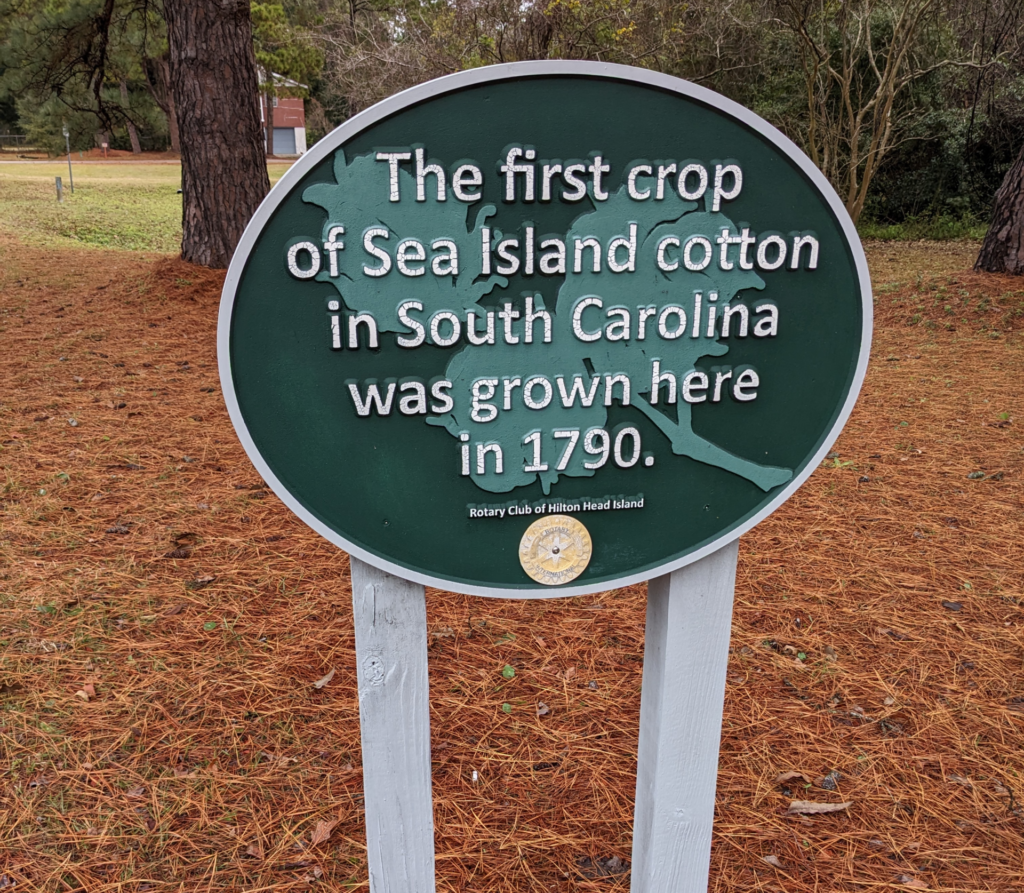
In what is today the Chaplin community of Hilton Head, on land that previously belonged to the Driessen family, is a sign that reads: “The first crop of Sea Island cotton in South Carolina was grown here in 1790″. According to this story about the Journal of Thomas B. Chaplin (1822-1890; of St. Helena Island); William Elliott of Hilton Head Island raised the first successful crop of long-staple cotton in South Carolina, in 1790. Great fortunes awaited those who followed his example. Estates that had risen and fallen with indigo grew rich again. Thomas B. Chaplin’s grandfather (John Chaplin) probably built the Big House at Tombee with the profits from his first Sea Island cotton crops. Thomas Chaplin’s mother, Isabella, married four times and accumulated five plantations and nearly 300 slaves, making her one of the richest women in America on the eve of the Civil War. Her third husband was Thomas’s father.
According to ‘South Carolina Encyclopedia’, William Elliott III (April 27, 1788–February 3, 1863): “Author, planter, politician. Elliott was the scion of one of South Carolina’s wealthiest and most distinguished families. He was born on April 27, 1788, in Beaufort, descended from the pioneer families of the old Beaufort District, principally the Elliotts and the Barnwells. His father, William Elliott II, was a patriot soldier in the Revolutionary War and pioneer of Sea Island cotton culture in South Carolina. As a consequence, William Elliott III, the eldest son, became one of the wealthiest planters in South Carolina. In 1860 he owned twelve plantations in the lowcountry; a summer home in Flat Rock, North Carolina; and 217 slaves.
John Chaplin arrived in Carolina in April 1672. There is a ‘Chaplin Creek’ near the confluence of Stono and Kiawah Rivers (north of Seabrook Island). John Chaplin, Jr., married Phoebe, daughter of John Ladson, and settled on St Helena Island before 1716. His descendants owned Chaplin Plantation (the original, “Tombee Plantation” – or “Tom B Chaplin” – St Helena Island – Beaufort County).
According to “Roots and Recall” “Old Hilton Head Names”): Their grandson, William Fripp Chaplin (1767-1830) in 1820 owned 400-acre Chaplin Plantation on the Atlantic between Mathew’s Folly Field and Pope’s Leamington Plantations. Shortly thereafter he purchased 400-acre Marshlands Plantation from the Estate of Thomas Webb. He married (1) Catherine Toomer by whom he had fifteen children and (2) Harriet Martinangel by whom he had an additional child. Both estates were entirely lost to the Chaplin family at the confiscation; the name Chaplin Plantation still endures.
This sign makes no reference to the fact that Chaplin was once a slave plantation. William Elliott II, who owned “Myrtle Bank Plantation” (near Dolphin Head, in what is now called “Hilton Head Plantation”), is the person credited for first successfully growing this variety of cotton in 1790. Therefore, it is unknown why the first crop of Sea Island Cotton is referenced as being grown at Chaplin Plantation instead of Myrtle Bank Plantation. However, it is clear that these two plantations were both active on Hilton Head around the same time (early 1800’s).
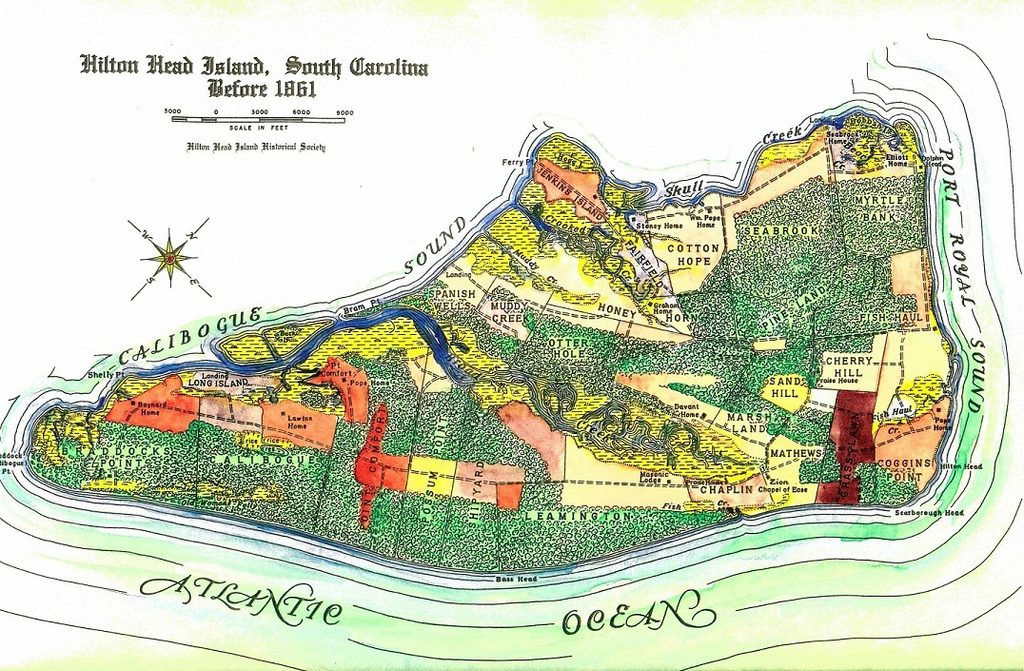
Since the end of the Civil War, and the establishment of Mitchelville in 1862 (the original, self-governing town of formerly enslaved people on Hilton Head Island); the island was predominately occupied by African Americans (who came to be known as Gullah). These folks continue to live in communities (mostly) outside of the ‘gated’ PUD’s (Planned Unit Developments – or as they are also still known to this day, as “plantations“). Until the 1950’s, these Gullah families continued to account for the majority of residents on Hilton Head.
Chaplin Historic Gullah Neighborhood (Copied directly from “Lowcountry Gullah”)
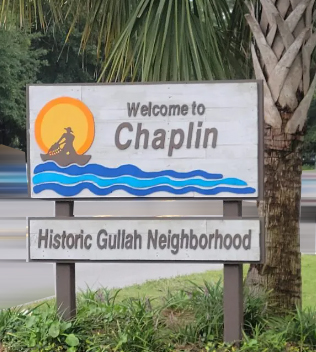
As the most southern Gullah neighborhood on the island, Chaplin runs shore to shore between the Broad Creek and the ocean where Burke’s, Singleton, and Collier beaches are today.
Primarily a farming community owned by the Gullah families of the Burkes, Brown’s, Ferguson’s, Singleton’s, and Collier’s (I will add to this, the “Christopher” and ‘Driessen” families); Chaplin was not only a key commercial area in the center of the island, it also became quite a sought after destination in the 1900’s. As a result of segregation, the Chaplin area was a popular place for Blacks from communities as far as Savannah to come to enjoy the beach. In addition to several pavilions and ocean side juke joints, in addition to local Gullah families who were skilled in cast net making and basketweavers, Chaplin was a second home for Black doctors from Savannah.
The blended community was the perfect place to unwind and enjoy the beauty of the island. Fish frys and the latest dances at Burke’s Hideaway could be found, in addition to an occasional visit from Chitterling Circuit performers like Tina and Ike Turner.
A praise house was also located in Chaplin, and around 1887, it’s estimated that the historic Gullah Central Oak Grove Missionary Baptist Church was formed. The community includes the Joe Pope Cemetery as well as the former site of a one-room Chaplin Elementary School.